
Your Local Mortgage Lender
Helping Clients All Throughout California
Personalized Mortgage Experience
JR Younathan offers personalized service and loan options you'll love. We shop multiple lenders to find the best rate and product for you, getting you into your dream home faster.
With wholesale interest rates and cutting-edge technology, we make the mortgage process seamless. Trust the experts who focus solely on mortgages. Support your local community and experience elite client service.
Let us help you achieve your homeownership dreams!
The Home Loan Process
Mortgage Pre-Approval
Get pre-approved from one of our Loan Officers to see how much you can afford.
House Shopping
Work with a trusted Real Estate Agent to find a home you would like to move into.
Loan Application
Complete your home loan application to get the lending process started.
Don't take my word for it
Mortgage Programs
Experience the best mortgage experience located in Ontario, California.
Home Loan Options
Our experienced mortgage advisors will walk you through the best mortgage loan program that will fit your specific scenario.
Conventional Home Loans.
FHA Home Loans.
USDA Home Loans.
VA Home Loans.
DSCR Loans.
Constructions Loans.
Frequently Asked Questions
How often can I refinance my mortgage?
There is no limit to the number of times you can refinance. However, you must qualify every time you apply and there will be costs associated with closing the loan each time.
Can I buy a home if I do not have money for a down payment?
Yes! There are a number of bond programs that offer low or no down payment financing options.
How do I know which mortgage is right for me?
The key to choosing the right mortgage is to understand the range of options and features available to you, as well as your budget, circumstances, and goals. Our licensed mortgage professionals are here to help you navigate that process. The more you know, the more comfortable and confident you will be choosing the best option for you and your family.
How long will the loan process take?
The Truth in Lending Act (TILA) does not permit a lender to close a loan until at least seven (7) business days have passed from the date your application was received. A typical home loan takes 30 days, as a number of third-party services such as appraisals, title work, and credit are required in conjunction with the mortgage process. Once you familiarize your Loan Officer with the details of your specific loan scenario, they will be able to provide you with a more specific timeline.
Will I qualify for a home loan?
The only way to find out is to speak with a qualified mortgage professional. Our Loan Officers have helped numerous clients who didn’t know if they could qualify to become home owners. We take the time to understand your financial situation and long-term financial goals, and then match you with the loan program that best fits your needs. Your approval for a loan may also largely depend on the price of the home you are financing. Getting pre-qualified prior to beginning your home search can give you an idea of what you may be able to afford.
Why do people refinance their mortgages?
Homeowners typically refinance to save money, either by obtaining a lower interest rate or by reducing the term of their loan. Refinancing is also a way to convert an adjustable loan to a fixed loan or to consolidate debts.
How much money will I have to pay upfront to buy a home?
This question does not have a simple, one-size-fits-all answer. The exact amount will depend on the price of the home you buy as well the type of mortgage financing you choose. Depending on your loan program, your down payment could be as much as 20% of the home’s price or as little as 3%, while some loans require no down payment at all.
Can I get a mortgage after bankruptcy?
You may still qualify for a home loan even if you have experienced a bankruptcy. The best way to find out if you qualify is to talk with a Loan Officer to discuss your options. Be sure to bring all paperwork regarding your bankruptcy so your Loan Officer can find the program that best fits your situation.
Should I lock my interest rate now, or wait until we are closer to our closing?
Interest rates fluctuate all day, every day. If an interest rate is good, it may be in your best interest to lock now. If you wait, you run the risk of an increase in rates later. If you are concerned that rates may go down after you lock, contact your Loan Officer to discuss your options. Some programs allow you to lock for an extended period and choose to lower your rate should a better one become available.
Most Recent Blog Updates
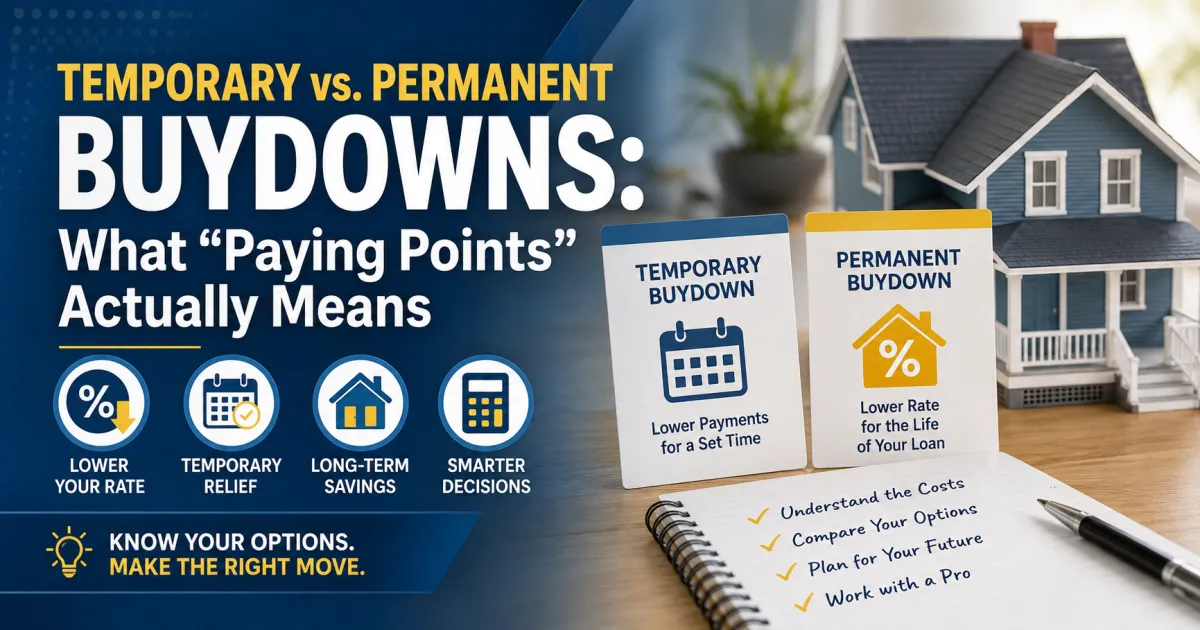
Temporary vs. Permanent Buydowns: What "Paying Points" Actually Means
Buydowns come up in almost every conversation I have with clients. What are they? How do they work? And more importantly — how do you know if one is right for you?
I'm JR, Regional Sales Manager with Sunflower Bank here in California, and today I want to break down both types of buydowns so you can walk into your next conversation with a mortgage loan officer knowing exactly what to ask.
First, Let's Clear Up "Points"
A lot of people call buydowns "points." And what I hear constantly is, "I don't want to pay points."
That's a completely fair position — but let's make sure you understand what it means. In most cases, paying pointsisbuying down your interest rate. You're paying a little more in fees up front to get a better rate. Whether that's a good trade depends entirely on your situation, which is exactly what we're going to unpack.
Buydowns come in two forms:permanentandtemporary. They work very differently.
Permanent Buydowns
A permanent buydown is when you pay a certain amount up front to reduce your interest rate for the entire life of the loan. That lower rate is your rate — for as long as you have the mortgage.
The rule of thumb here is one question:where's the break-even point?
How long before your monthly savings add up to what the buydown cost you?
Here's a simplified example (not an offer of credit or a rate quote — just illustrating the math). Say you have a $400,000 loan and you pay one percentage point, which is $4,000. That might buy your rate down by a quarter percent or three-eighths of a percent. The question is: how long does it take those smaller payments to recoup that $4,000? Six months? A year? Two years? Three?
That recoupment period is the most important number in the conversation, and a good loan originator will take the time to walk you through it — because it needs to line up with your actual life plans.
Consider this: you're buying a home, but you're family planning and you know you'll need something bigger in two to three years. If the buydown takes three years to break even, was it the right call? You may never realize the full benefit of what you paid.
The Flip Side: Premium Pricing
Just as you can pay to buy a rate down, you can also take a rate slightlyhigherthan the standard no-point rate. That's called premium pricing, and that premium can be used to cover your closing costs.
We see a lot of buyers doing this in today's higher-rate market, on the expectation that rates will come down at some point and they'll refinance anyway. Why pay to buy down a rate you don't plan to keep?
Temporary Buydowns
A temporary buydown does exactly what the name says — it reduces your interest rate for a limited period. But the mechanics are completely different from a permanent buydown.
You'll see these described as a3-2-1, a2-1, or a1-1.
Take the 3-2-1. Over three years:
Year 1: your note rate is reduced by 3 percentage points
Year 2: reduced by 2 percentage points
Year 3: reduced by 1 percentage point
Your payment steps up each year until it reaches your full note payment in year four.
Why Would Someone Do This?
A few common reasons:
You're easing into homeownership.It's your first mortgage and a full payment feels intimidating right out of the gate.
You expect your income to grow.Maybe you have raises coming, or you just launched a business and want a couple of years for it to ramp before taking on the full payment.
You have excess seller or builder concessions.This is what we're seeing most in today's market. If a seller or builder is offering more in concessions than your fees require, that money has to go somewhere useful — and a temporary buydown is often where it goes.
How the Money Actually Works
This part matters. Let's use a 2-1 buydown on a $400,000 loan.
In year one, your payment is reduced by 2%, which works out to roughly$6,200in interest savings. In year two, the reduction drops to 1% — roughly$3,100. Your payment steps up, but it's still below the note rate.
Total benefit: about$9,300over two years.
Here's the catch: that $9,300 is prepaid at closing. Which prompts the natural reaction — "So I'm bringingmoremoney to closing to get a lower payment for two years? Why not just make the payments as I go?"
And you'd be right to ask. That's exactly why this strategy shines when the money isn't coming out of your pocket. If you've negotiated excess seller or builder concessions into your purchase contract, those funds can go toward the temporary buydown, and you get a materially lower payment for the first two years without spending your own cash.
At closing, that $9,300 goes into an escrow account. Each month, the escrow releases the difference and it's added to your payment automatically. You don't have to do anything.
What Happens If You Move or Refinance?
This is one of the most common questions I get — and the answer is in yourbuydown agreement. Read it. It's included in your initial disclosures, and it spells out exactly what happens under different scenarios with the specific lender you're working with.
That said, here's how most agreements handle it. Using our 2-1 example: say you make it through year one and then get a job change and need to move. There's still roughly $3,100 sitting in that escrow account. In most cases, those unused funds arecredited toward the principal of your loan at payoff. The money doesn't just disappear.
One important exception: most temporary buydown agreements have a separate clause for buydowns paid for bylenderpremiums. Those typically donotget credited back. But if the buydown was paid by you, a builder, or a seller concession, you should see that credit applied at payoff.
Again — read your buydown agreement. That's where the specifics live.
So Which One Is Right for You?
Honestly, it depends. Your life circumstances, where the financial markets are, what you expect interest rates to do — all of it plays into whether a temporary buydown, a permanent buydown, or neither makes sense.
If you don't have a seller concession coming, a temporary buydown may not be worth it at all. That same money could go toward paying down principal from day one, covering your fees, or staying in your savings account. Sometimes that's the smarter play.
And pricing moves every single day as the markets move. You never know exactly where you'll catch it.
The easy thing is to just take whatever rate you can get at zero points and move on with your life. Sometimes that's genuinely the right answer. But sometimes it isn't — and you won't know unless you have the conversation.
My encouragement: work with a pro.Someone who will take the time and has the tools to actually show you the numbers. We use worksheets specifically built to lay out temporary versus permanent buydowns side by side over time, so you can see whether it makes good financial sense foryoursituation.
Those are all good questions to ask. If you'd like to talk through them, I'd love to have that conversation with you — reach out anytime.
JR Younathan is a Regional Sales Manager and licensed mortgage loan originator with Sunflower Bank, N.A., serving California. Examples in this article are hypothetical and for illustration only. This is not an offer of credit or a commitment to lend. Sunflower Bank, N.A. | Equal Housing Lender

Mortgage Calculator
See your total mortgage payments using the tool below.
| Year | Interest | Principal | Balance |
|---|

Contact Us
(909) 576-0550
3990 Concours Street, Ste 310 Ontario, California 91764
JR Younathan, N.A. is committed to providing a website that is accessible to the widest possible audience, in accordance with applicable standards and guidelines. We are actively working to increase accessibility and usability of our website to everyone, including individuals with disabilities.
Our website endeavors to comply with the Web Content Accessibility Guidelines (WCAG) 2.1 Level AA standards. If you have difficulty accessing any part of our website, or have suggestions for improvement, please call us at (909) 576-0550.
We will work with you to provide the information you need in an accessible format.
We welcome your feedback and are committed to continually improving our website's accessibility.
